

Logo Diván Ψ Cine — Psicoanálisis y Cine — Lic. Javier Azarola Diván Ψ Cine
Diván Ψ Cine Logo — Psychoanalysis and Cinema — Lic. Javier Azarola Diván Ψ Cine
Psicoanálisis en extensión · Cine · Deseo y alteridad
Psychoanalysis in extension · Cinema · Desire and alterity

Querer poseer al otro: lo que una película de terror revela sobre el deseo

Wanting to possess the other: what a horror film reveals about desire

Lo que una película de terror revela sobre el deseo, la alteridad y la destrucción del vínculo.

What a horror film reveals about desire, alterity, and the destruction of the bond.

Lic. Javier Azarola
Lic. Javier Azarola Psicólogo clínico · Mat. N° 89.410 23 de junio de 2026
Lic. Javier Azarola
Lic. Javier Azarola Clinical psychologist · Lic. N° 89.410 June 23, 2026
Obsession (2025) — Curry Barker

A veces algunas películas dejan entrever, a través del horror, algo que ya está ocurriendo en la cultura, pero el lenguaje del cine permite verlo claramente. Obsession (2025), del director y youtuber Curry Barker, es una de esas películas.

Con un presupuesto de menos de un millón de dólares y filmada en 20 días, recaudó 148 millones a nivel mundial; el éxito de taquilla también dice algo sobre el nervio que tocó.

La premisa es simple. Bear (Michael Johnston) es un empleado de una tienda de música, tímido, enamorado de su amiga de la infancia Nikki (Inde Navarrette). En lugar de animarse a decirle lo que siente, compra en un negocio de antigüedades un artefacto llamado "One Wish Willow" (un juguete que supuestamente concede un deseo si se lo rompe) y pide que Nikki lo ame más que a nadie en el mundo. El deseo se cumple. Y ahí empieza el horror.

Este artículo propone leer esa historia desde dos marcos teóricos: la filosofía de Byung-Chul Han sobre la erosión del Eros en la cultura contemporánea, y la clínica psicoanalítica desde Jacques Lacan sobre la constitución del sujeto y su relación con el deseo del Otro.

I. La lógica del deseo que no soporta el "no"

Bear se percibe a sí mismo como un "buen chico": sensible, paciente, merecedor de una oportunidad, y ahí reside exactamente la trampa que la película desmonta.

En su libro La agonía del Eros, Byung-Chul Han describe una paradoja del sujeto contemporáneo: vivimos en una época de abundancia de opciones para el amor, y sin embargo el Eros se encuentra en agonía. ¿Por qué? Porque el Eros requiere algo que esta cultura no tolera fácilmente: la alteridad radical del otro.

El Eros, para Han, va mucho más allá de la atracción o el deseo de fusión: apunta hacia algo que no se deja poseer, que nos excede, que nos transforma. Requiere lo que él llama la "atopía" del otro: su cualidad de ser irreductible, de sustraerse a nuestro control. Es esa diferencia la que genera el deseo. Cuando el otro se vuelve predecible, transparente, accesible en todo momento, el deseo se extingue.

Bear rechaza esa alteridad. No ama a Nikki como sujeto autónomo; él está enamorado de una imagen que él mismo construyó. Cuando ella no responde a esa imagen, o sea, cuando no le da el "sí" que él necesita, Bear no soporta el rechazo. En vez de aceptar la impotencia del deseo no correspondido, usa el poder (la varita) para forzar la reciprocidad.

Han llamaría a esto el paso del Eros a la posesión. Y la consecuencia es exactamente la que muestra la película: al obtener lo que pedía, Bear no obtiene amor, sino a una esclava.

"Al forzar el amor, el otro deja de ser un Tú para convertirse en un objeto consumible."

Esto plantea una paradoja clínica que la película muestra muy bien: al eliminar el deseo autónomo de Nikki, Bear también destruye la fuente de su propio deseo. Ahora ya tiene lo que quería pero está peor que antes.

II. La des-subjetivación de Nikki: cuando el otro desaparece

El horror central de Obsession opera en un registro diferente al del gore sobrenatural: lo que le sucede a Nikki.

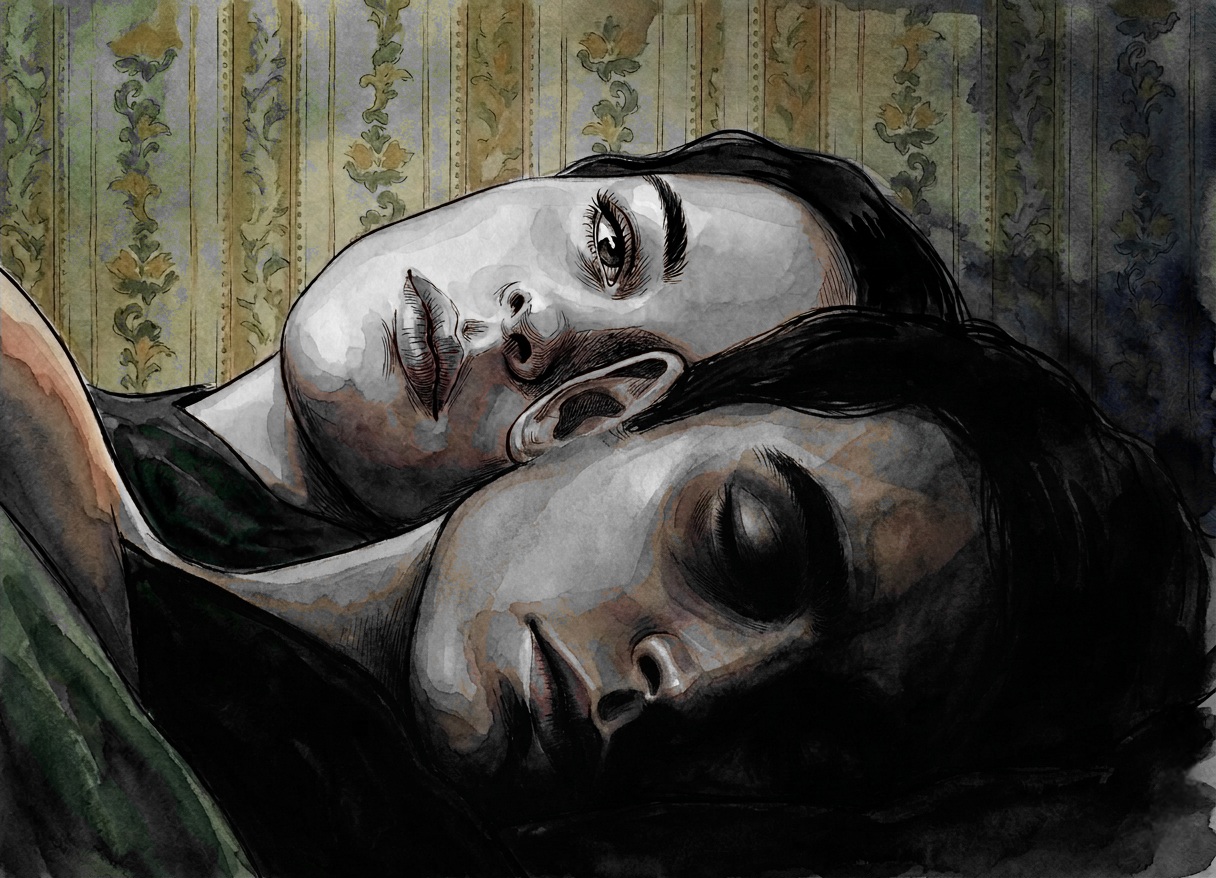
Antes del deseo, Nikki es inteligente, sarcástica, autónoma. Después del deseo, se convierte en otra cosa: una versión mecánica de sí misma, que ama a Bear con una intensidad maniaca y parece haber perdido acceso a su propio pensamiento. Los gritos repentinos, los actos de violencia contra sí misma, el doble perturbador que parodia la toxicidad de Bear tienen una lógica clínica.

El fading del sujeto

En la teoría lacaniana, el sujeto aparece y desaparece en el lenguaje: algo que se constituye en el vínculo con el Otro y puede ser obturado por su demanda. Lacan llamaba fading (eclipse, desvanecimiento) a ese fenómeno.

Nikki sufre ese eclipse de manera radical. Su deseo (que es lo que la constituye como sujeto) es reemplazado por el deseo de Bear. Ella ya no desea: es deseada para cumplir un deseo ajeno. Su cuerpo sigue funcionando, pero ella, como sujeto, ha sido borrada. Lo que queda es la versión de Nikki que Bear necesitaba que existiera.

Pero este eclipse de Nikki va más allá todavía. El psicoanalista Éric Laurent, en su trabajo sobre la clínica del autismo, describe lo que ocurre cuando el cuerpo de un sujeto deja de estar articulado por agujeros que permitan que algo se vacíe en algún lugar1; un cuerpo sin vias de descarga, invadido por la excitación, el cual ya no tiene dónde depositarla, y entonces el sujeto mismo "se vacía". Esta imagen describe lo que la película muestra en Nikki después del deseo de Bear: su deseo fue sustituido, y el cuerpo deja de ser un lugar habitable al mismo tiempo. Ya no hay un adentro donde alojar lo que le pasa, y por eso lo que le pasa se desborda hacia afuera, en gritos, en violencia sobre sí misma, en una intensidad que no encuentra cauce.

El cuerpo como lugar de lo real

Cuando el sujeto pierde su voz, cuando no puede simbolizar lo que le está pasando, el conflicto retorna en el cuerpo. Los gritos de Nikki, sus episodios de autolesión, no son simplemente efectos del horror sobrenatural: son los únicos rastros de que algo en ella todavía resiste. Son lo que Lacan llamaría la irrupción de lo real: aquello que no puede ser representado y que por eso irrumpe como exceso, como grito, como violencia sobre el propio cuerpo.

Nikki sufre en un infierno interior mientras su cuerpo actúa una comedia romántica. El dolor físico es la única prueba de existencia que le queda.

Laurent va incluso más lejos al pensar el estatuto de la voz en estos cuadros. Cuando ya no hay un sujeto que pueda servirse del lenguaje para representar lo que le pasa, hablar deja de ser un acto que transmite un sentido: se vuelve, dice Laurent, un "acontecimiento de cuerpo", un arrancamiento real. No como en la historia en la que hay un síntoma que pueda interpretarse: es el cuerpo mismo extrayendo algo de sí, como quien se desprende de un objeto del que no puede separarse de otro modo. Por eso los gritos de Nikki no remiten a un significado oculto que haya que descifrar. Son, literalmente, lo único que le queda como acto de enunciación: la última forma en que ese cuerpo puede decir que ahí, todavía, hay algo.

La "Freaky Nikki" y el transitivismo

Hay un momento particularmente inquietante en la película: cuando aparece una versión de Nikki que empieza a imitar y parodiar la toxicidad de Bear. La "Freaky Nikki".

Lacan describió el fenómeno del transitivismo ya en su tesis de 1932 sobre la paranoia, en una de sus formas más tempranas. La idea, tomada de la psicología infantil, es que en el momento en que el yo se constituye por identificación con la imagen del otro, las posiciones de agresor y agredido todavía no están fijadas: son intercambiables desde el origen. Un chico que pega también puede llorar como si le hubieran pegado a él, o decir "él me pegó" cuando fue al revés. Lo propio y lo ajeno todavía no están del todo separados.

En el caso clínico que Lacan analiza en esa tesis (el de Aimée, una mujer que ataca a una actriz), esto se vuelve más claro: Aimée castiga en la otra algo que en realidad es un conflicto propio, algo que ella misma no puede tolerar desear. El conflicto es suyo, pero solo puede aparecer bajo la forma de algo que el otro le hace. Es una autopunición que necesita pasar primero por afuera para poder ser vivida.

Algo de esa misma lógica organiza la aparición de la Freaky Nikki. No es simplemente una versión distorsionada de Bear que aparece afuera, amplificada por un espejo. Es la estructura misma de su deseo, posesivo, totalizante, que no tolera la falta, la que vuelve ocupando el lugar del otro. Bear creó una esclava, y lo que no podía reconocer como propio en ese gesto (que amar, para él, era exactamente eso: poseer sin resto) ahora le llega desde Nikki, como si fuera ella la que lo persigue a él. La autopunición está ahí: Bear termina castigado por lo que él mismo instaló, pero solo puede vivirlo como algo que le hacen, no como algo que hizo, de modo que Bear termina experimentando el asfixiante parasitismo que él mismo impuso.

Lo más perturbador de la Freaky Nikki, entonces, más que ella sea una versión monstruosa de Nikki, es que es exactamente el mensaje de Bear, dirigido a Bear, desde el lugar donde él creía haber instalado a su objeto. Él puso ahí algo que pudiera amarlo sin condiciones, sin resto, sin alteridad. Y lo que recibe a cambio es esa misma lógica devuelta como acoso, como exigencia, como posesión total, pero ahora dirigida hacia él. El espejo no le muestra a Nikki. Le muestra a Bear lo que él mismo había sido todo el tiempo, solo que ahora no puede negarlo ni desviar la mirada.

III. El "Nice Guy" como estructura clínica

La lógica clínica del personaje de Bear resulta bastante reconocible dentro de la estructura obsesiva que Lacan describió.

El obsesivo, en la estructura lacaniana, tiene una relación particular con el deseo: lo necesita imposible para poder seguir deseando. Mientras Nikki no lo correspondía, Bear podía idealizarla sin riesgo. La amenaza real para el obsesivo llega cuando el otro lo acepta: en ese momento, tiene que enfrentar la castración, la falta, el hecho de que ningún objeto colma realmente el deseo.

Bear evita ese encuentro usando la magia. No se expone a la vulnerabilidad del deseo real, no tolera el "no puede poder" que implica amar a alguien que tiene su propia vida, su propio deseo, su propia alteridad. Prefiere la fantasía (aunque sea monstruosa) antes que la ausencia.

Hay una frase que el director Curry Barker señaló en entrevistas: "Bear no consigue amor, consigue un esclavo". Pero hay algo más que eso: al esclavizar el deseo de Nikki, Bear queda a su vez esclavizado a lo que esclavizó, ya que deseo se extingue porque ya no hay un Otro que le responda desde su propia diferencia.

La positividad absoluta del deseo cumplido se vuelve monstruosa; sin la resistencia del otro, el amor pierde la tensión que lo hacía posible y deriva en pesadilla.

IV. Lo que el cine de terror muestra e ilustra la teoría

Las mejores películas de terror son las que capturan algo de la cultura difícil de expresar, y lo vuelven visible a través del horror. Obsession lo hace con la lógica del deseo posesivo en la era del narcisismo.

El personaje de Bear condensa una figura cultural bien reconocible en la década de 2020: el hombre que se percibe como "buena persona" y que, precisamente por eso, siente que merece ser correspondido. El resentimiento que surge cuando el otro no cumple esa expectativa, la incapacidad para tolerar la autonomía ajena como algo legítimo y no como un obstáculo.

La película no tiene una mirada moralizante ni condenatoria. Lo muestra con empatía suficiente para que resulte incómodo: porque Bear es también un sujeto sufriente, atrapado en su propia lógica, sin las herramientas para salir de ella.

Conclusión posible

Obsession es molesta e incomoda. El director Curry Barker lo dijo sin rodeos: su cine busca provocar angustia, incomodidad, ansiedad. Y lo logra. Muestra (un sujeto que no puede tolerar la alteridad del otro, que prefiere destruirlo antes que aceptar su irreductibilidad) es algo que no ocurre solo en las películas de terror.

El amor que aplasta la autonomía del otro termina destruyendo también al que lo ejerce.

Y eso, paradójicamente, es lo más esperanzador del filme: que muestra la catástrofe con suficiente claridad como para que valga la pena pensar en ella.

1 Para Laurent (siguiendo a Lacan), el cuerpo no es solo el organismo biológico, sino una superficie que el lenguaje y la relación con el Otro perforan en ciertos puntos: boca, ano, oídos, ojos, etc. (los llamados orificios pulsionales). Esos agujeros no son simplemente anatómicos; son los lugares donde algo del cuerpo puede salir o entrar en relación con el Otro: la voz que sale por la boca, la mirada que entra por los ojos, lo que se evacúa, lo que se incorpora.

Marco teórico de referencia

  1. Han, B.-C. (2012). La agonía del Eros. Herder.
  2. Lacan, J. (1966). Escritos 2. Siglo XXI.
  3. Lacan, J. (1964). El Seminario, libro 11: Los cuatro conceptos fundamentales del psicoanálisis. Paidós.
  4. Lacan, J. (1932/1976). De la psicosis paranoica en sus relaciones con la personalidad. Siglo XXI.
  5. Laurent, É. (2013). La batalla del autismo: De la clínica a la política. Grama Ediciones.

Obsession (2025). Dir. Curry Barker. Producción: Blumhouse Productions / Capstone Pictures. Distribución: Focus Features (EEUU) / Universal Pictures (internacional). Estreno en cines: 15 de mayo de 2026. Duración: 109 minutos.

Material de divulgación · No reemplaza la consulta profesional · © Lic. Javier Azarola · psicoazarola.com.ar

También puede interesarte

Diván Ψ Cine — todas las lecturas psicoanalíticas del cine Tren a Busan: el padre que llegó tarde La pared que nos mira: extimidad, malestar urbano y deseo en Medianeras El suplente: lo que transmite quien no tiene cargo El padre que no sabe pero está: Homero Simpson y la función paterna

¿Algo de esto resonó con tu propia historia?

Psicoterapia online para adultos y adolescentes · Sin lista de espera Hacer una consulta

Some films allow us to glimpse, through horror, something that is already happening in the culture — but the language of cinema makes it possible to see it clearly. Obsession (2025), by director and YouTuber Curry Barker, is one of those films.

Made on a budget of under one million dollars and shot in 20 days, it grossed 148 million worldwide; box-office success also says something about the nerve it touched.

Bear (Michael Johnston) is a shy music-store employee, in love with his childhood friend Nikki (Inde Navarrette). Rather than telling her how he feels, he buys an antique artefact called the "One Wish Willow" — a toy that supposedly grants a wish when broken — and asks that Nikki love him more than anyone in the world. The wish comes true. And that is where the horror begins.

This article proposes reading that story through two theoretical frameworks: Byung-Chul Han's philosophy on the erosion of Eros in contemporary culture, and Lacanian psychoanalytic theory on the constitution of the subject and its relation to the desire of the Other.

I. The logic of desire that cannot bear "no"

Bear perceives himself as a "nice guy": sensitive, patient, deserving of a chance. That is precisely the trap the film dismantles.

In his book The Agony of Eros, Byung-Chul Han describes a paradox of the contemporary subject: we live in an era of abundant options for love, and yet Eros finds itself in agony. Why? Because Eros requires something this culture does not easily tolerate: the radical alterity of the other.

Eros, for Han, goes far beyond attraction or the desire for fusion: it points toward something that resists possession, that exceeds us, that transforms us. It requires what he calls the other's "atopy" — their quality of being irreducible, of withdrawing from our control. It is that difference which generates desire. When the other becomes predictable, transparent, accessible at all times, desire is extinguished.

Bear rejects that alterity. He does not love Nikki as an autonomous subject; he is in love with an image he himself constructed. When she does not respond to that image — that is, when she does not give him the "yes" he needs — Bear cannot bear the rejection. Instead of accepting the helplessness of unrequited desire, he uses power (the wishing stick) to force reciprocity.

Han would call this the passage from Eros to possession. And the consequence is exactly what the film shows: in obtaining what he asked for, Bear does not obtain love — he obtains a slave.

"By forcing love, the other ceases to be a You and becomes a consumable object."

This poses a clinical paradox that the film illustrates well: by eliminating Nikki's autonomous desire, Bear also destroys the source of his own desire. Now he has what he wanted, and he is worse off than before.

II. Nikki's de-subjectification: when the other disappears

The central horror of Obsession operates in a different register: what happens to Nikki.

Nikki enters the film as an intelligent, sarcastic, autonomous person; after the wish, she becomes a mechanical version of herself, who loves Bear with manic intensity and seems to have lost access to her own thoughts. The sudden screams, the acts of self-harm, the disturbing double that parodies Bear's toxicity — all of this has a clinical logic.

The fading of the subject

In Lacanian theory, the subject appears and disappears in language: something that is constituted in the relation to the Other and can be obstructed by its demand. Lacan called this phenomenon fading — eclipse, vanishing.

Nikki undergoes that eclipse in a radical way. Her desire (which is what constitutes her as a subject) is replaced by Bear's desire. She no longer desires: she is desired in order to fulfil someone else's desire. Her body keeps functioning, but she, as a subject, has been erased. What remains is the version of Nikki that Bear needed to exist.

But this eclipse goes further still. The psychoanalyst Éric Laurent, in his work on the clinic of autism, describes what happens when a subject's body is no longer articulated by openings that allow something to drain away; a body without outlets, invaded by excitation, which no longer has anywhere to deposit it — and so the subject itself "empties out." This image describes what the film shows in Nikki after Bear's wish: her desire has been replaced, and the body ceases to be an inhabitable place at the same time. There is no longer an interior in which to lodge what is happening to her, and so what happens to her overflows outward — in screams, in violence against herself, in an intensity that finds no channel.

The body as the place of the real

When the subject loses her voice, when she cannot symbolise what is happening to her, the conflict returns in the body. Nikki's screams and her episodes of self-harm are not simply effects of supernatural horror: they are the only traces of something in her that still resists. They are what Lacan would call the irruption of the real — that which cannot be represented and which therefore erupts as excess, as scream, as violence against one's own body.

Nikki suffers in an interior hell while her body performs a romantic comedy. Physical pain is the only proof of existence she has left.

Laurent goes even further in thinking about the status of the voice in these cases. When there is no longer a subject who can use language to represent what is happening, speaking ceases to be an act that transmits meaning: it becomes, Laurent says, a "body event" — a real tearing away. Not like in the story where there is a symptom that can be interpreted: it is the body itself extracting something from itself, like someone detaching from an object they cannot separate from in any other way. That is why Nikki's screams do not point to a hidden meaning waiting to be deciphered. They are, literally, the only thing left to her as an act of enunciation: the last way in which that body can say that here, still, there is something.

The "Freaky Nikki" and transitivism

There is a particularly disturbing moment in the film: when a version of Nikki appears that begins to imitate and parody Bear's toxicity. The "Freaky Nikki."

Lacan described the phenomenon of transitivism already in his 1932 thesis on paranoia, in one of its earliest forms. The idea, drawn from child psychology, is that in the moment when the ego is constituted through identification with the image of the other, the positions of aggressor and victim are not yet fixed: they are interchangeable from the origin. A child who hits may also cry as if they had been hit, or say "he hit me" when it was the other way around. What is one's own and what belongs to the other are not yet fully separated.

In the clinical case Lacan analyses in that thesis (that of Aimée, a woman who attacks an actress), this becomes clearer: Aimée punishes in the other something that is in reality her own conflict, something she herself cannot tolerate desiring. The conflict is hers, but it can only appear in the form of something the other does to her. It is a self-punishment that needs to pass through the outside first in order to be experienced.

Something of that same logic organises the appearance of Freaky Nikki. She is not simply a distorted version of Bear that appears from the outside, amplified by a mirror. It is the very structure of his desire — possessive, totalising, unable to tolerate lack — that returns to occupy the place of the other. Bear created a slave, and what he could not recognise as his own in that gesture (that loving, for him, was exactly that: possessing without remainder) now reaches him from Nikki, as if it were she who is pursuing him. The self-punishment is there: Bear ends up punished by what he himself installed, but can only experience it as something that is being done to him, not as something he did, so that Bear ends up experiencing the suffocating parasitism he himself imposed.

What is most disturbing about Freaky Nikki, then, is not that she is a monstrous version of Nikki — it is that she is exactly Bear's message, addressed to Bear, from the place where he thought he had installed his object. He put there something that could love him unconditionally, without remainder, without alterity. And what he receives in return is that same logic sent back as harassment, as demand, as total possession — but now directed at him. The mirror does not show him Nikki. It shows Bear what he himself had been all along, except that now he can no longer deny it or look away.

III. The "Nice Guy" as a clinical structure

The clinical logic of Bear's character falls squarely within what Lacan described as the obsessive structure.

The obsessive, in Lacanian structure, has a particular relationship with desire: he needs it to remain impossible in order to keep desiring. While Nikki did not reciprocate, Bear could idealise her without risk. The real threat for the obsessive arrives when the other accepts him: at that moment, he must face castration, lack, the fact that no object truly satisfies desire.

Bear avoids that encounter by using magic. He does not expose himself to the vulnerability of real desire, cannot tolerate the "cannot manage" that loving someone with their own life, their own desire, and their own alterity entails. He prefers the fantasy — however monstrous — over absence.

There is a phrase that director Curry Barker noted in interviews: "Bear doesn't get love, he gets a slave." But there is something more: by enslaving Nikki's desire, Bear becomes in turn enslaved to what he enslaved — because desire is extinguished when there is no longer an Other who responds from their own difference.

The absolute positivity of fulfilled desire becomes monstrous; stripped of the other's resistance, love loses the tension that made it possible and slides into nightmare.

IV. What horror cinema shows and theory illuminates

The best horror films are those that capture something in the culture that is difficult to express and make it visible through horror. Obsession does this with the logic of possessive desire in the age of narcissism.

Bear's character condenses a cultural figure readily recognisable in the 2020s: the man who perceives himself as a "good person" and who, precisely because of this, feels he deserves to be reciprocated. The resentment that arises when the other does not meet that expectation, the inability to tolerate the other's autonomy as something legitimate rather than as an obstacle.

The film does not adopt a moralising or condemnatory perspective. It shows things with enough empathy to be uncomfortable: because Bear is also a suffering subject, trapped in his own logic, without the tools to get out of it.

A possible conclusion

Obsession is unsettling and uncomfortable. Director Curry Barker said it plainly: his cinema sets out to provoke anguish, discomfort, anxiety. And it succeeds. What it shows — a subject who cannot tolerate the other's alterity, who prefers to destroy it rather than accept its irreducibility — is something that does not only happen in horror films.

The love that crushes the other's autonomy ends up destroying the one who exercises it.

And that, paradoxically, is what is most hopeful about the film: that it shows the catastrophe with enough clarity to make it worth thinking about.

Theoretical references

  1. Han, B.-C. (2012). The Agony of Eros. MIT Press.
  2. Lacan, J. (1966). Écrits. Norton.
  3. Lacan, J. (1964). The Seminar of Jacques Lacan, Book XI: The Four Fundamental Concepts of Psychoanalysis. Norton.
  4. Lacan, J. (1932/1976). De la psicosis paranoica en sus relaciones con la personalidad. Siglo XXI.
  5. Laurent, É. (2013). La batalla del autismo: De la clínica a la política. Grama Ediciones.

Obsession (2025). Dir. Curry Barker. Production: Blumhouse Productions / Capstone Pictures. Distribution: Focus Features (USA) / Universal Pictures (international). Released: May 15, 2026. Runtime: 109 minutes.

Educational material · Does not replace professional consultation · © Lic. Javier Azarola · psicoazarola.com.ar

You might also like

Diván Ψ Cine — all psychoanalytic readings of cinema Train to Busan: the father who arrived too late The Wall That Watches Us: extimacy, urban malaise and desire in Medianeras El suplente: what is transmitted by someone without a post The father who doesn't know but is there: Homer Simpson and the paternal function

Did something here resonate with your own story?

Online therapy for adults and adolescents · No waiting list Book a consultation