Psicoanálisis en extensión · Fútbol · Cultura
Psychoanalysis in Extension · Football · Culture
El Mundial y la falta: lo que noventa minutos prestan sin poder devolver
The World Cup and the Lack: what ninety minutes lend without ever giving back
Un partido no cura nada. Por noventa minutos, sin embargo, pone en orden eso que el resto del año anda suelto. Una lectura psicoanalítica del Mundial.
A match cures nothing. For ninety minutes, though, it puts in order what stays loose the rest of the year. A psychoanalytic reading of the World Cup.
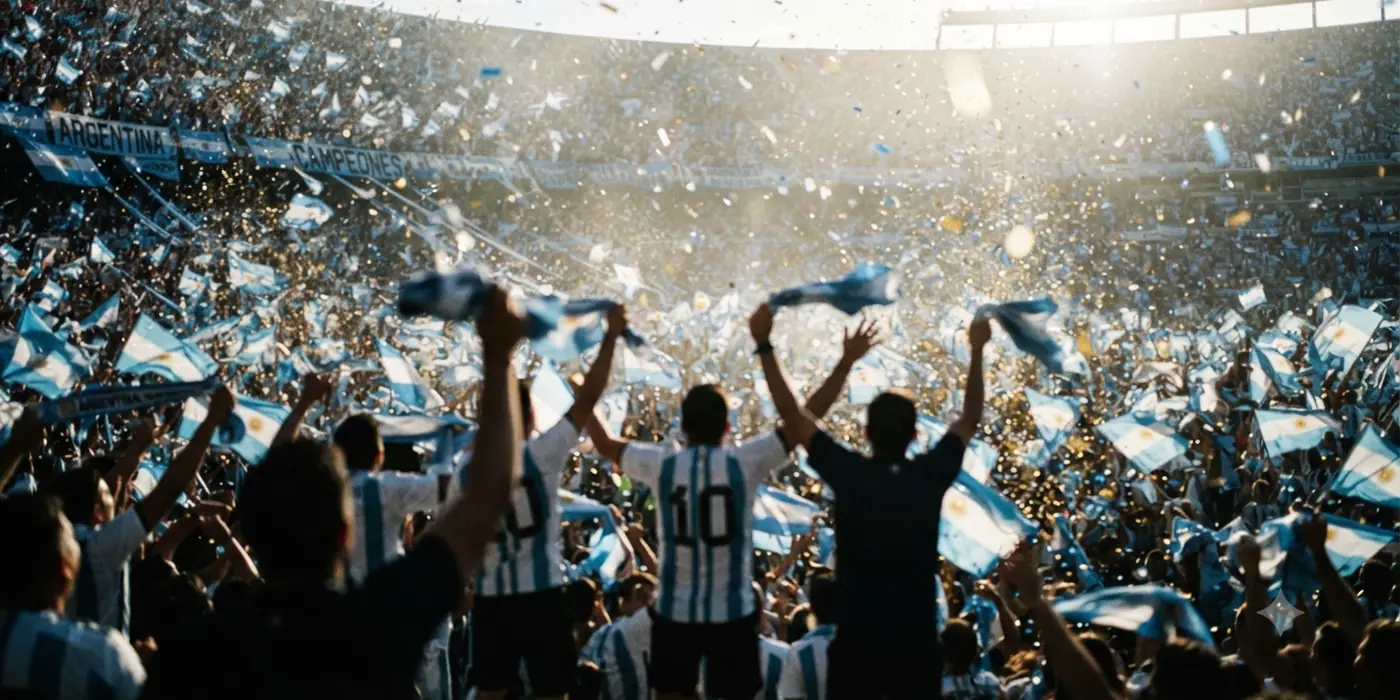
Cada cuatro años llega un momento en el que un país entero deja de discutir sobre lo que lo divide para discutir sobre lo mismo. Durante ese mes un mismo tema ordena la conversación colectiva y da la sensación de que todos miramos en la misma dirección, más allá de lo que termine pasando en la cancha. Ese fenómeno, tan simple en apariencia, tiene una anatomía bastante más compleja cuando se lo mira desde el psicoanálisis.
Nunca terminé de creer que eso sea solo entretenimiento. Hay algo ahí que se parece más a lo que Freud describía en El porvenir de una ilusión cuando hablaba de la religión: una creencia sostenida por los deseos más viejos y urgentes que tenemos, un lugar que el sujeto necesita que exista aunque sepa, en el fondo, que es una construcción. El Mundial ocupa ese lugar cuatro semanas cada cuatro años. Emocionarse con una selección tiene su propia lógica: ese objeto, la Copa, el equipo, el héroe de turno, viene a ocupar un lugar que estaba vacío desde mucho antes de que empezara el torneo. En una época donde buena parte de las decisiones importantes de nuestra vida quedaron en manos de algoritmos, mercados y automatismos que no vemos ni entendemos del todo, el jugador que "saca la cara" por el equipo funciona como una figura de potencia prestada, alguien que por noventa minutos parece tener el control de la situación.
Esa ilusión de control, claro, choca todo el tiempo con el resultado, y ahí aparece una escena que cualquiera reconoce si alguna vez discutió un partido en un grupo de WhatsApp: cuando el equipo pierde, rara vez se acepta sin más, y enseguida aparece el árbitro que "nos robó", o el técnico que "no entendió nada", o simplemente la mala suerte que en algún momento tenía que tocarnos. Esas explicaciones funcionan como la forma en que el psiquismo protege una idealización que no puede permitirse abandonar de golpe.
Un hueco con forma de pelota
Nadie persigue realmente la pelota. Lo que se persigue es lo que ella promete y nunca termina de entregar, y esa distancia (entre lo que se busca y lo que se encuentra) es más vieja que el fútbol mismo. Lacan la nombró de un modo que suena técnico pero que describe algo muy concreto: el objeto a, esa cosa que el deseo persigue sin poder alcanzar del todo, porque lo que realmente lo mueve es el vacío que ese objeto viene a señalar. La pelota es eso: el punto alrededor del cual una multitud entera organiza, durante noventa minutos, toda su energía y su atención, un objeto redondo que carga con mucho más peso simbólico del que dos equipos se disputan sobre el césped.
La nación como ideal frágil
El psicoanalista uruguayo Marcelo Viñar trabajó bastante esta idea de que el "nosotros" nacional funciona como un Yo Ideal colectivo, y que ese ideal es tan potente como frágil. El fútbol junta a gente que en cualquier otro contexto no tendría demasiado en común, y por eso mismo los partidos más tensos, los que la gente llama "infartantes", funcionan como el momento exacto en que ese ideal compartido queda expuesto a la posibilidad real de romperse, mucho más allá del entretenimiento intenso que parecen a simple vista. Ganar sostiene la fantasía de un país unido y potente; perder devuelve, aunque sea por un rato, la sensación más incómoda de fragmentación y desamparo.
Freud agrega una pieza más en El malestar en la cultura: buena parte de esa unión hacia adentro se sostiene con hostilidad hacia afuera. Cuanto más se parece un rival a uno, mismo continente, mismo idioma, historia entrelazada, más intensa suele ser la rivalidad. Freud lo llamaba el narcisismo de las pequeñas diferencias: no hace falta demasiada distancia real para fabricar un enemigo, alcanza con una camiseta de otro color. La identidad nacional que el Mundial pone en escena se arma, en gran parte, contra alguien, y esa hostilidad organizada es también lo que le da tanta intensidad emocional al asunto.
Lo interesante es que ambas cosas, la euforia y el derrumbe, vienen del mismo lugar; toda identificación nacional carga con el riesgo de la pérdida que la acompaña, y cuanto más fuerte es la ilusión de unidad, más doloroso resulta el momento en que el resultado la desmiente.
Lo que pasa en el cuerpo durante los minutos finales
Franco "Bifo" Berardi describe una sensación que cualquiera que haya visto un Mundial reconoce en el cuerpo antes que en la cabeza: esa sensación de aceleración nerviosa en los últimos minutos de un partido cerrado, cuando cada segundo se estira y el sistema nervioso entra en una especie de sobregiro. Berardi lo llama espasmo: un sacudón que la infoestimulación constante (las repeticiones, los primeros planos, el ruido del relato en tiempo real) produce en un cuerpo que ya no procesa la información de manera consciente y que reacciona, en cambio, de forma casi automática.
Después llega el desenlace, y con él una especie de descarga. Si el equipo gana, esa descarga se vive como alivio, casi como remedio: por un rato, el caos de la vida cotidiana tiene sentido. Si pierde, el mismo mecanismo se invierte y aparece un vacío particular, esa tristeza rara del día después de una eliminación, que a veces sorprende por su intensidad, sobre todo si se la compara con lo poco que, en el fondo, ese resultado cambia la vida de cualquiera.
Habitar la falta
Quizás lo que puede decirse del Mundial, desde esta mirada, sin adornarlo, es que no cura nada. No resuelve la precariedad laboral de nadie ni le devuelve poder a quien no lo tiene. Mucho menos llena el vacío que cada uno carga por vivir en un mundo que se siente cada vez más gobernado por fuerzas que no controlamos. Ofrece, eso sí, un paréntesis: un lugar donde esa falta se puede vivir de otra manera, colectivamente, con otros cuerpos alrededor gritando lo mismo que uno.
Disfrutar ese paréntesis es parte de la experiencia; el problema empieza cuando se espera que dure, cuando se apagan las pantallas y el país vuelve a discutir de lo que discutía antes, y la falta que el Mundial suturó por un mes sigue estando ahí, intacta.
Una imagen del Papa Francisco sirve de contraste para pensar esto: la de la Iglesia como un hospital de campaña, un lugar que atiende primero las heridas concretas de la gente y deja la doctrina para después. El Mundial se aleja bastante de esa imagen: un espectáculo que junta multitudes pero que, apenas termina, las deja más o menos donde estaban, con las mismas heridas de antes, solo que ahora sin la anestesia del partido. Lo que queda pendiente, el resto del año, es qué hacemos con esa misma necesidad de sentido compartido que un mes de fútbol deja tan a la vista.
Referencias bibliográficas
- Berardi, F. (2019). Futurabilidad: La era de la impotencia y el horizonte de la posibilidad. Caja Negra Editora.
- Freud, S. (2012). El malestar en la cultura. Amorrortu Editores. (Obra original publicada en 1930).
- Freud, S. (2012). El porvenir de una ilusión. Amorrortu Editores. (Obra original publicada en 1927).
- Lacan, J. (1964). El Seminario, Libro 11: Los cuatro conceptos fundamentales del psicoanálisis. Paidós.
- Viñar, M. (2014). La ruina de los ideales y la clínica del trauma. En Mundo contemporáneo y subjetividad.
Material de divulgación · No reemplaza la consulta profesional · © Lic. Javier Azarola · psicoazarola.com.ar
¿Te pasa algo parecido viendo un partido?
Psicoterapia online para adultos y adolescentes · Sin lista de espera
Hacer una consulta
Every four years there's a moment when an entire country stops arguing over what divides it to argue about the same thing instead. For that month, a shared topic orders the collective conversation and creates the sense that everyone is looking in the same direction, regardless of what ends up happening on the field. That phenomenon, so simple on the surface, has a considerably more complex anatomy once it's looked at through psychoanalysis.
I've never quite believed that's just entertainment. There's something there that looks a lot like what Freud described in The Future of an Illusion when he talked about religion: a belief sustained by the oldest and most urgent wishes we have, a place the subject needs to exist even while knowing, deep down, that it's a construction. The World Cup occupies that place for four weeks every four years. Getting emotional over a national team has its own logic: that object, the Cup, the team, the hero of the moment, comes to occupy a place that had been empty long before the tournament began. In an era where a good part of the important decisions in our lives have ended up in the hands of algorithms, markets, and automatisms we neither see nor fully understand, the player who "carries the team on his back" functions as a figure of borrowed potency, someone who for ninety minutes seems to have control over the situation.
That illusion of control, of course, keeps colliding with the actual result, and that's where a scene shows up that anyone recognizes if they've ever argued about a match in a WhatsApp group: when the team loses, it's rarely accepted just like that, and soon enough the referee who "robbed us" appears, or the coach who "didn't understand a thing," or simply the bad luck that had to catch up with us sooner or later. Those explanations work as the way the psyche protects an idealization it can't afford to give up all at once.
A hole shaped like a ball
Nobody is really chasing the ball. What's being chased is what it promises and never finishes delivering, and that distance (between what's sought and what's found) is older than football itself. Lacan named it in a way that sounds technical but describes something very concrete: the objet a, that thing desire chases without ever fully reaching it, because what actually drives it is the void that object points to. The ball is that: the point around which an entire crowd organizes, for ninety minutes, all its energy and attention, a round object that carries far more symbolic weight than what two teams dispute on the grass.
The nation as a fragile ideal
The Uruguayan psychoanalyst Marcelo Viñar worked extensively on the idea that the national "we" functions as a collective Ego Ideal, and that this ideal is as powerful as it is fragile. Football brings together people who, in any other context, wouldn't have much in common, and that's exactly why the tensest matches, the ones people call "heart-stopping," work as the exact moment when that shared ideal is exposed to the real possibility of breaking, well beyond the intense entertainment they appear to be at first glance. Winning sustains the fantasy of a united, powerful country; losing brings back, if only for a while, the far more uncomfortable feeling of fragmentation and helplessness.
Freud adds another piece in Civilization and Its Discontents: much of that inward cohesion is sustained by hostility directed outward. The more a rival resembles us, same continent, same language, intertwined history, the more intense the rivalry tends to be. Freud called this the narcissism of small differences: it doesn't take much real distance to manufacture an enemy, a jersey of another color is enough. The national identity the World Cup puts on display is built, largely, against someone, and that organized hostility is also part of what gives the whole thing so much emotional intensity.
What's interesting is that both things, the euphoria and the collapse, come from the same place; every national identification carries the risk of loss that comes with it, and the stronger the illusion of unity, the more painful the moment when the result contradicts it.
What happens in the body during the final minutes
Franco "Bifo" Berardi describes a sensation that anyone who has watched a World Cup recognizes in the body before recognizing it in the mind: that sensation of nervous acceleration in the final minutes of a tight match, when every second stretches out and the nervous system goes into a kind of overdrive. Berardi calls it spasm: a jolt that constant info-stimulation (replays, close-ups, the noise of real-time commentary) produces in a body that no longer processes information consciously and instead reacts almost automatically.
Then the outcome arrives, and with it a kind of discharge. If the team wins, that discharge is experienced as relief, almost as a remedy: for a while, the chaos of everyday life makes sense. If it loses, the same mechanism reverses and a particular emptiness appears, that strange sadness of the day after an elimination, which sometimes surprises by its intensity, especially compared with how little that result actually changes anyone's real life.
Inhabiting the lack
Maybe the plainest thing that can be said about the World Cup, from this angle, is that it cures nothing. It doesn't resolve anyone's job precarity, nor does it hand power back to those without it. Least of all does it fill the void each person carries from living in a world that feels increasingly governed by forces beyond our control. What it does offer is a parenthesis: a place where that lack can be lived differently, collectively, with other bodies around shouting the same thing you are.
Enjoying that parenthesis is part of the experience; the trouble starts when it's expected to last, when the screens turn off and the country goes back to arguing about what it was arguing about before, and the lack the World Cup sutured for a month is still there, intact.
An image of Pope Francis offers a useful contrast for thinking about this: the Church as a field hospital, a place that tends to people's concrete wounds first and leaves doctrine for later. The World Cup sits pretty far from that image: a spectacle that gathers crowds but that, the moment it ends, leaves them more or less where they were, with the same wounds as before, only now without the anesthesia of the match. What's left, the rest of the year, is figuring out what to do with that same need for shared meaning a month of football leaves so plainly in view.
References
- Berardi, F. (2017). Futurability: The Age of Impotence and the Horizon of Possibility. Verso.
- Freud, S. (1961). Civilization and Its Discontents. In The Standard Edition of the Complete Psychological Works of Sigmund Freud (Vol. 21). Hogarth Press. (Original work published 1930).
- Freud, S. (1961). The Future of an Illusion. In The Standard Edition of the Complete Psychological Works of Sigmund Freud (Vol. 21). Hogarth Press. (Original work published 1927).
- Lacan, J. (1981). The Seminar of Jacques Lacan, Book XI: The Four Fundamental Concepts of Psychoanalysis. Norton.
- Viñar, M. (2014). La ruina de los ideales y la clínica del trauma. In Mundo contemporáneo y subjetividad.
Educational material · Does not replace professional consultation · © Lic. Javier Azarola · psicoazarola.com.ar
Does this happen to you watching a match?
Online therapy for adults and adolescents · No waiting list
Book a consultation